
Guide
Enhancing therapy outcomes with automated wellbeing tracking

Overview
Guide is an early-stage B2B mental health platform helping therapists streamline practice management and improve patient engagement.
I first partnered with Guide during my capstone year, where our team spent a year exploring how therapists could better engage with their patients, post session through video content.
Through that exploration, we uncovered a fundamental challenge: video content was not the best solution and therapists needed a faster more qualitative way of connecting with their patients, which provided them with actionable insights. After graduation, I continued with Guide to address this gap.
Goals
The brief was to design a system to help therapists check in on patients between appointments. But as I dove into the problem, I realized we were missing a critical piece. This wasn't just about therapist workflows, it was also about patient retention.
I expanded the project scope to:
Enable automated check-ins during the critical 1-2 session window
Reduce patient drop-off by giving them a voice between sessions
Help therapists adapt their approach based on real-time feedback
Role
Product Designer
Timeline
August 2025- Present
Team
1x Founder,
2x Developers
1 Designer (Me)
Tools
Figma, Miro, Notion, Zoom, UserBerry, Twilio
Impact
65%
Reduction in patient-drop off
60%
Reduction in Time on Task
4x
more session engagement
PROBLEM
The Gap Between Sessions
Therapists typically see patients once a week or biweekly, creating 7-14 day gaps with zero visibility into patient wellbeing. During this time, patients process their sessions, navigate challenges, and sometimes struggle but therapists have no way of knowing until the next appointment.
Guide needed a way to bridge this disconnect, but the solution wasn't immediately obvious.
Understanding the Therapist Experience Sessions
To understand the root cause, I interviewed 5 therapists managing active caseloads of 20-40 patients each.
PAIN POINTS
Fragmented Systems
Therapists switch between Headway, Growtherapy, ChatGPT, and Google with no single view of patient progress.
No Feedback Loop
Therapists enter sessions uncertain if their previous approach helped. They're "flying blind" between appointments.
Silent Struggles
Some patients don't naturally open up. Without proactive outreach, early warning signs (declining mood, disengagement) go unnoticed.
Manual Check-ins Don't Scale
The few therapists who do check in rely on texts/emails. With 20-40 patients, this approach is inconsistent and unsustainable.
"I wish I knew if my approach from our last session actually helped. Right now, I'm going in blind until they tell me and some patients never bring it up."
— Licensed Therapist, 7 years experience
The Insight That Reframed Everything
Industry research showed the highest drop-off occurs after sessions 1–2—when trust is still forming.
I brought this insight to the founder: What if we designed Pulse Check not just to solve therapist workflows, but to actively reduce patient drop-off by intervening during this critical window?
The business case was clear: higher retention = sustainable growth. The care case was equally important: no patient should slip through the cracks of care.
How might we bridge the communication gap between sessions so therapists can act before patients drop off?
Designing the Right Questions
To understand what patients actually wanted to communicate between sessions, I asked 6 individuals in therapy: "What are the three main things you'd like your therapist to know between appointments?"
How are you feeling today?
How supported did you feel after our last session?
How prepared do you feel to apply what we discussed?
These three questions bridged the gap for both users: therapists got actionable insights, patients got a structured way to communicate without feeling burdensome.
DESIGN PROCESS
Observing the Gaps in Everyday Use
To design a feature that therapists would actually use, I first immersed myself in how post-session communication currently happened both within Guide and across the broader mental health space.
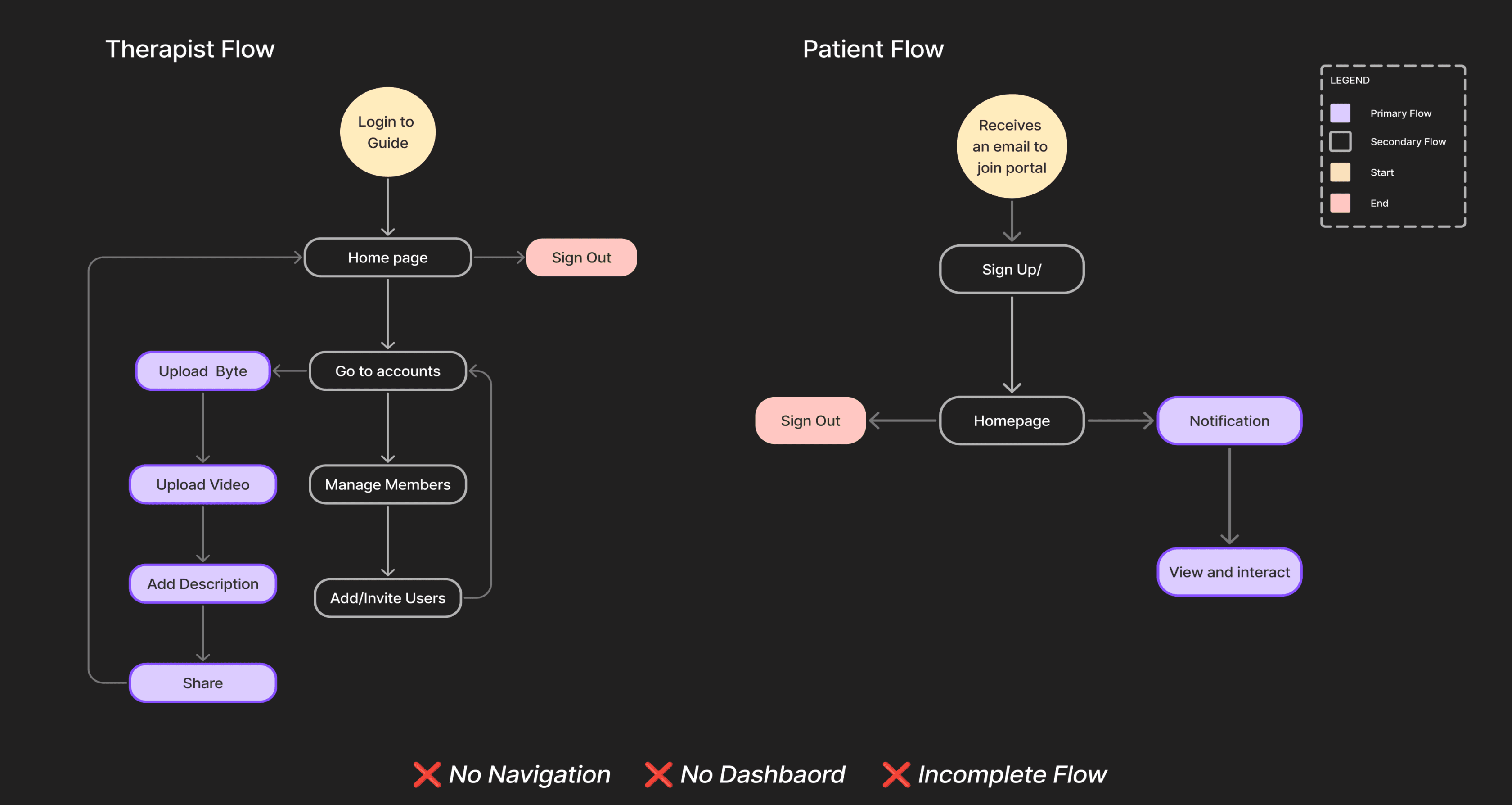
I reviewed existing platforms and mapped the existing workflow therapists followed inside Guide, tracing each step to see where check-ins naturally fit. This foundation ensured the new flow would build on familiar behaviors rather than introduce unnecessary complexity.
Too Many Clicks
1% of platforms offered post-session check-ins which were long, emotionally taxing, or clinically dense. This led to low completion rates.
No Dashboard
Guide lacked a central dashboard to view patient status or identify who needed attention causing signals to slip through the cracks.
CURRENT USER JOURNEY
PROPOSED USER JOURNEY
Designing the Ideal Experience
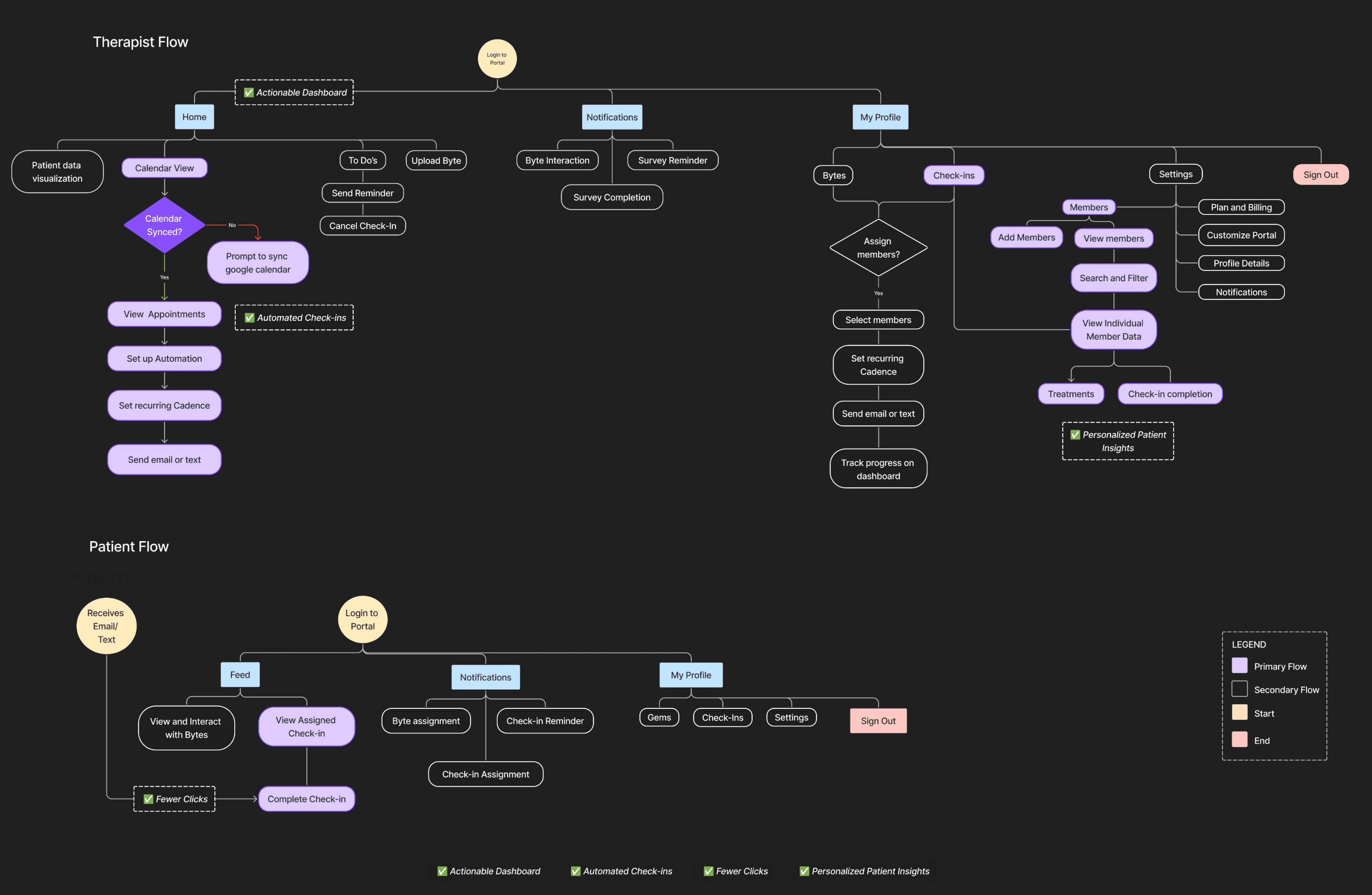
To ensure Pulse Check worked intuitively for both user groups, I mapped the ideal therapist and patient journeys side-by-side. This dual perspective clarified how check-ins should be created, delivered, completed, and monitored shaping both the therapist dashboard and the patient-facing experience.
A key recommendation was introducing a central dashboard, something Guide previously lacked to give therapists a clear view of patient status, check-in activity, and actionable next steps at a glance.
INITAL DESIGNS
Aligning Constraints With User-Centered Decisions
I started with sketches, then moved to mid-fidelity wireframes to shape the UX and flows before committing to visuals. This approach helped me design around two core constraints:
1. Engineering constraints: With a small development team, new patterns had to stay close to existing components. I needed to innovate just enough to solve user problems without creating technical overhead.
2. Research constraints: Therapists had limited time for testing, so mid-fidelity screens helped us validate structure and logic quickly without the distraction of polished UI.
Early explorations focused on how to organize information. Should the dashboard prioritize completion rates or patient lists? Where should automation controls live? How much detail should patient cards show?
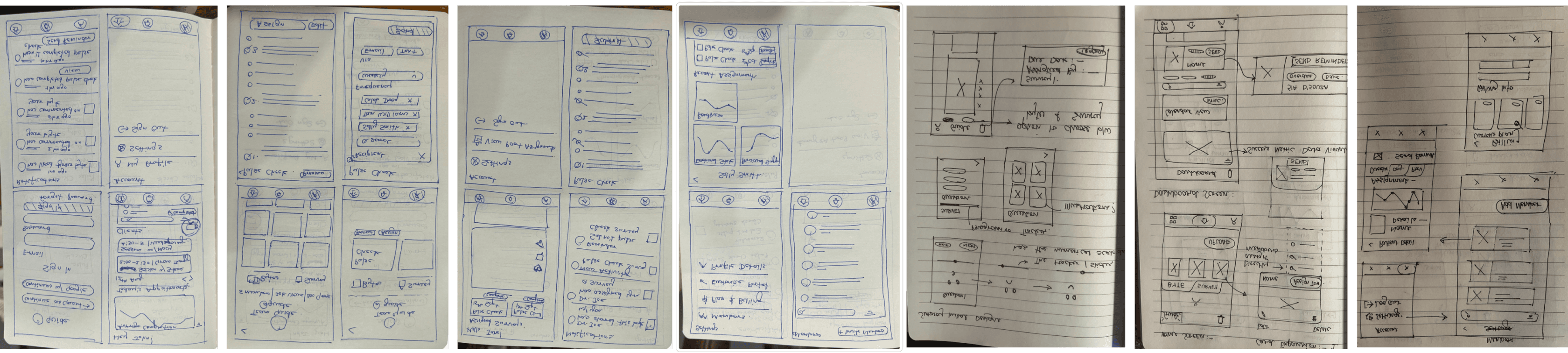
Initial Sketches
ITERATION AND TESTING 1
Checking the Structure Before Scaling
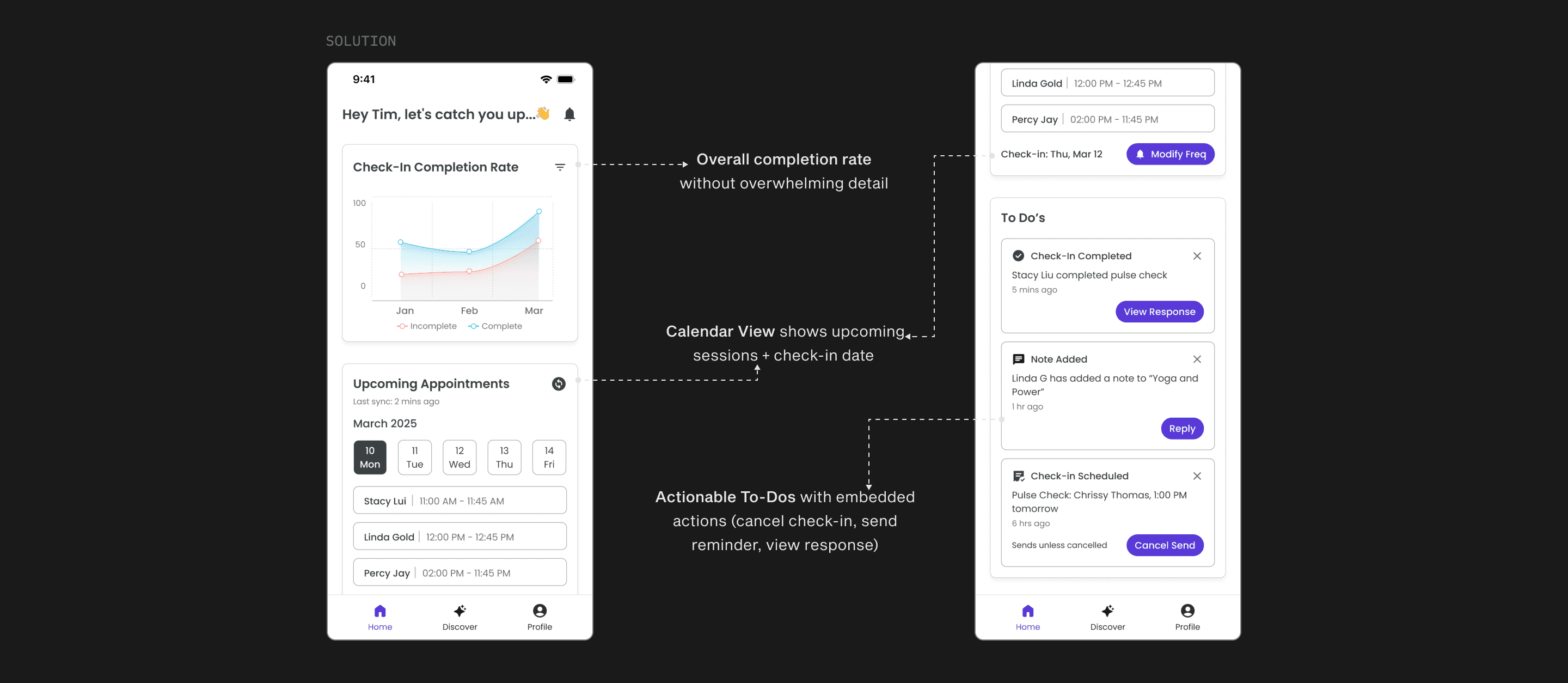
The first wireframes were a direct translation of sketches, a dashboard showing a list of clients, when pulse checks were assigned, and their current status.
Since this was a new domain for me, I needed to understand how therapists would interpret my designs and if it reflected their natural behavior. So before polishing anything further, I tested the early designs with real end users, to understand what made sense, what felt confusing and what needed to be rethought.
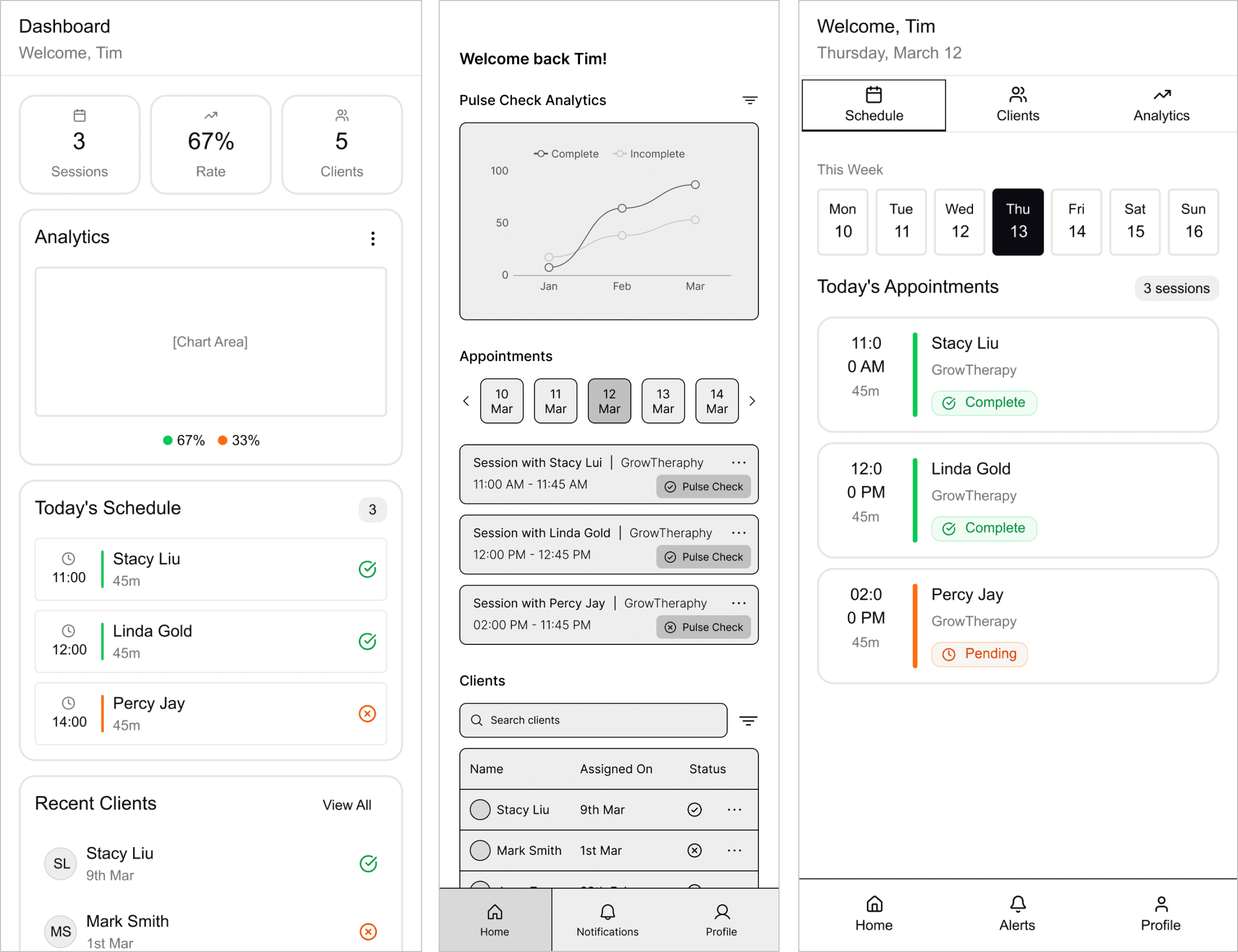
What did not work
Dashboard felt passive, not active
Therapists wanted to-dos upfront.
Unclear navigation to deeper views.
What worked
Patient information cards were clear
Therapists understood the check-in status indicators
Information architecture made sense
"Show me what I need to do today, then let me drill deeper"
ITERATION AND TESTING 2
But how and where do we send the check-in?
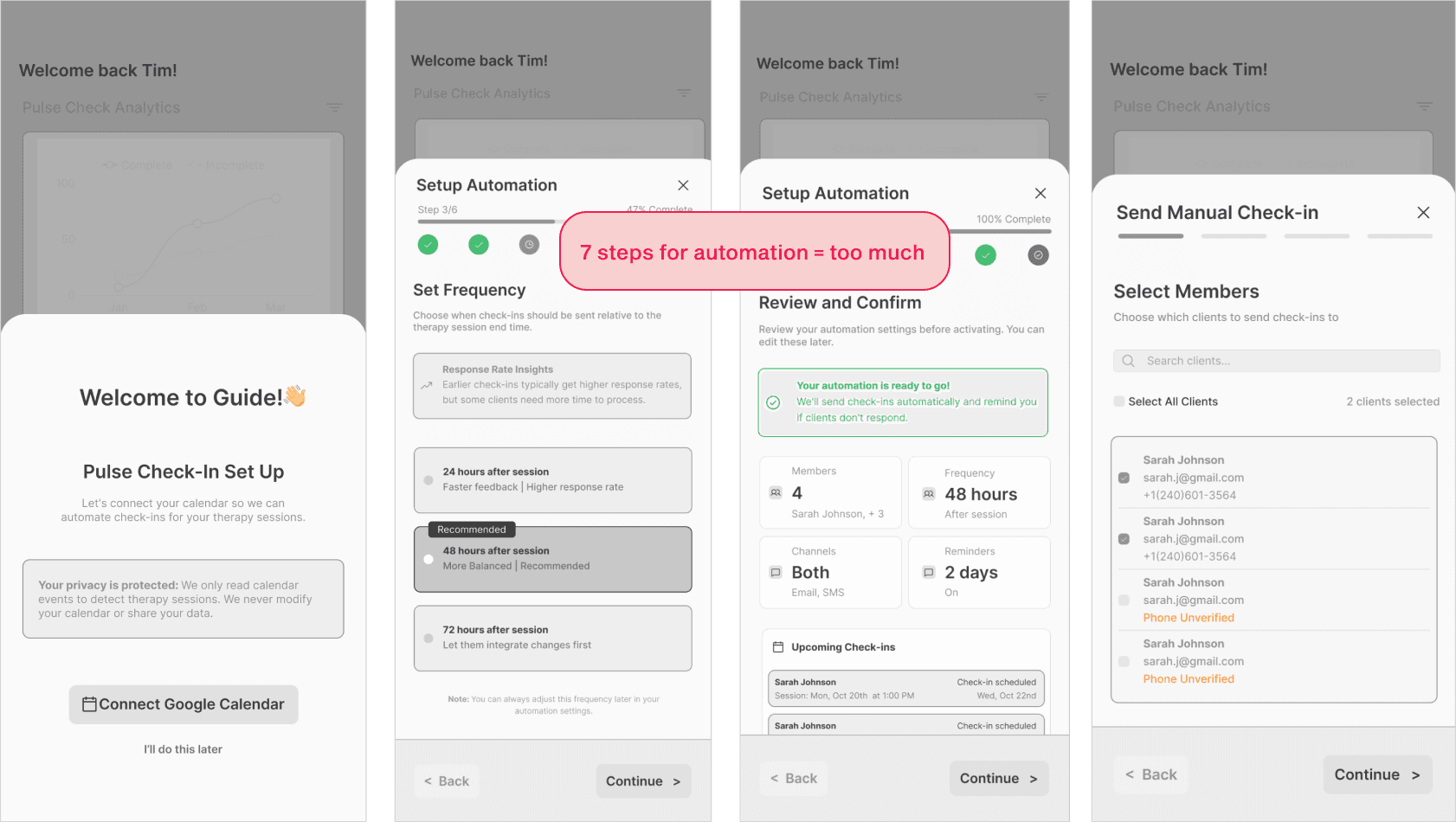
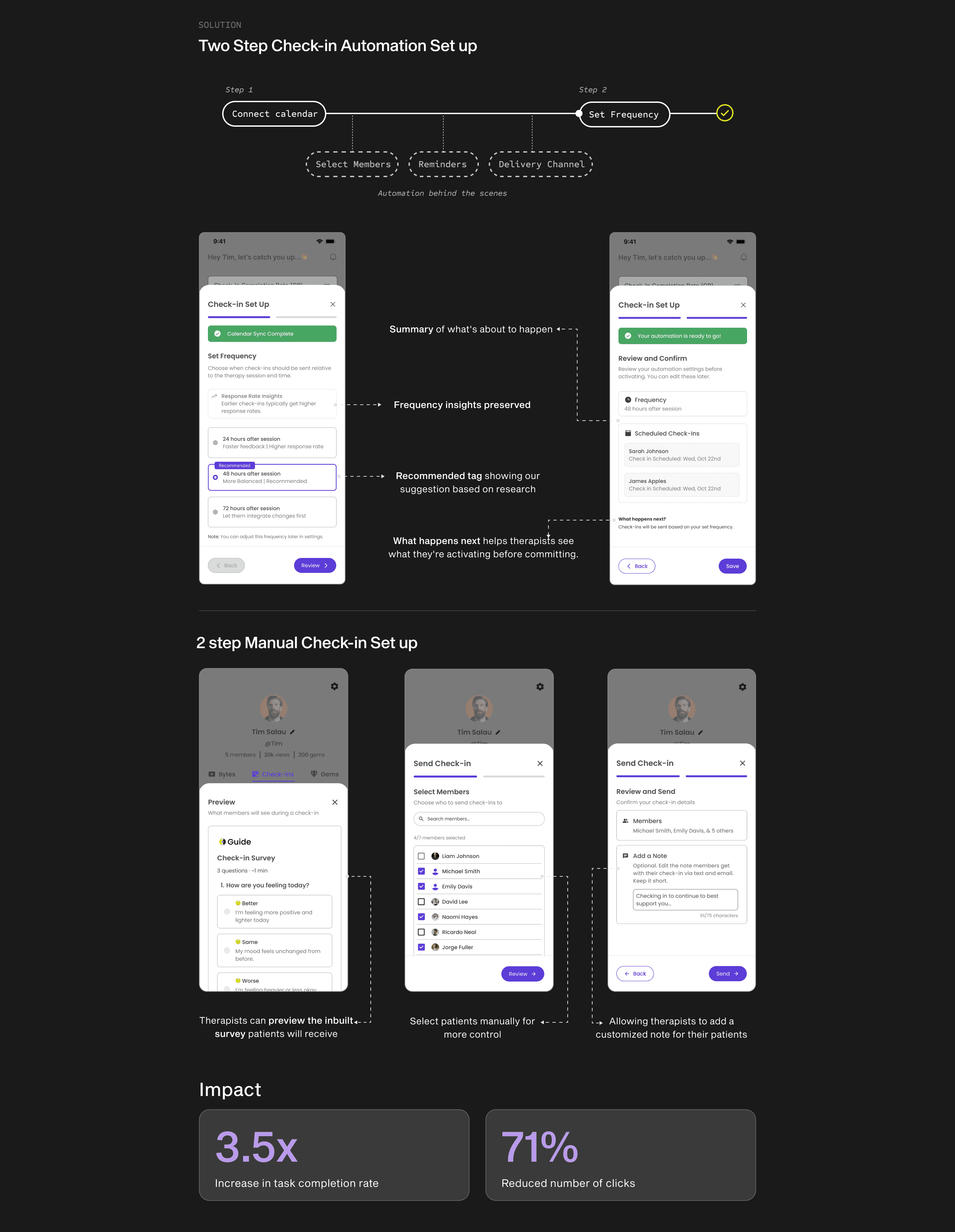
Initial designs gave therapists granular control. 7 steps to configure automation, 4 steps to send manual check-ins. User testing showed this created abandonment as most therapists wanted the fastest path to activation, not customization options. I redesigned both flows to 2-3 steps by implementing smart defaults and automating technical decisions.
What did not work
7 steps for setting up check-in automation and 4 steps for manual check-in was too much friction
What worked
“Is there a faster way to do this? This feels complicated”
ITERATION AND TESTING 3
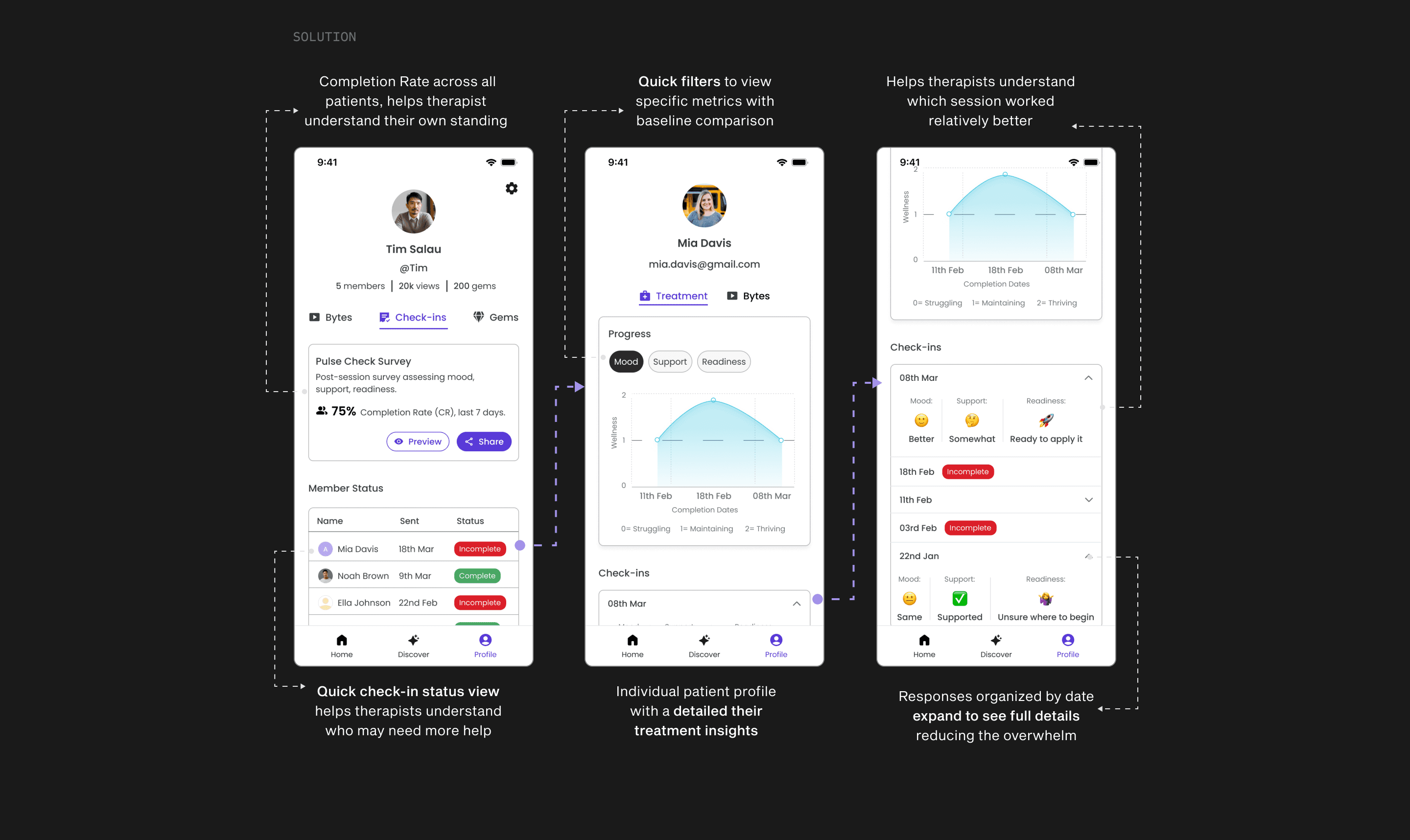
Making Deep Patient Data Discoverable
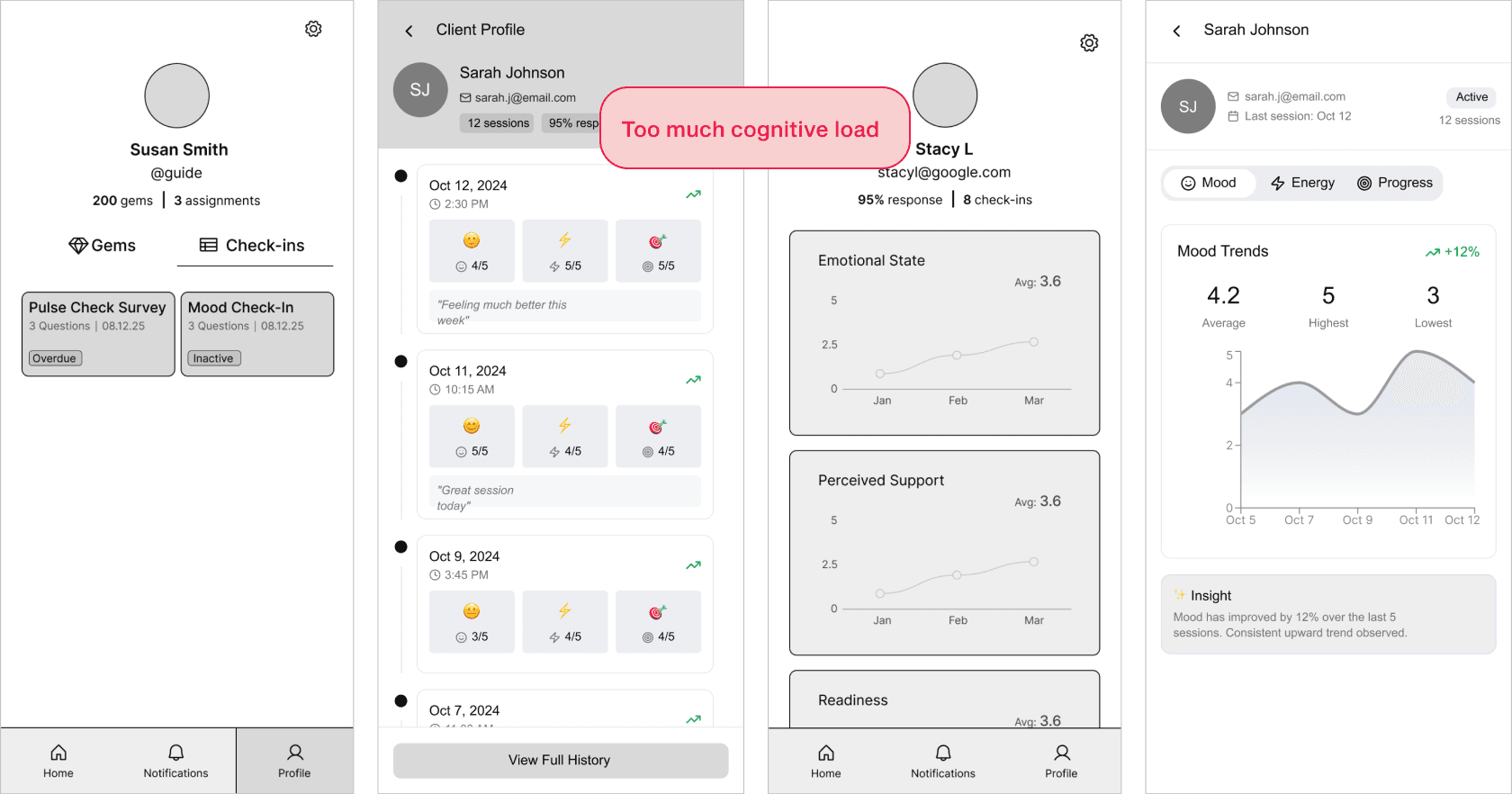
While automation and the dashboard were now functioning smoothly, we still hadn’t solved a key question: Where should therapists access patient trends and check-in history? Therapists needed patterns over time, emotional shifts, and individual progress.
What did not work
Modal from dashboard felt disconnected
Initial designs showed every response in full, overwhelming at a glance
No clear "baseline" for comparison
What worked
Therapists loved seeing trends visualized
Seeing all past check-ins in one place helped therapists prepare for sessions
"I'm clicking on a patient card... shouldn't this just take me to their full profile?"
A NEW PROBLEM AROSE
From Signals to Meaningful Patterns
Pulse Check shipped, and it worked. Check-in completion rose, drop-off fell, but a few weeks into real use, a different pattern emerged from watching therapists actually use it day to day.
Pulse Check had solved for getting patients to share how they were doing. It hadn't solved for what happened next: a therapist with 20-40 patients, now had more data arriving than they could realistically review by hand before every session.
It was no longer "how do we get signal." It was
How do we help therapists make sense of the signal, without asking them to read through weeks of check-ins before every appointment.
EARNING THE CASE FOR AI
Three Attempts, Three Honest Failures
We tested three approaches with the therapists we'd been talking to before landing on AI.
A better dashboard organized the data, but didn't interpret it. Manual flagging put that interpretation on the therapist directly, which worked until caseloads made it impossible to sustain. Rule-based alerts automated the flag, but couldn't tell the difference between noise and a real pattern, or explain why they'd fired.
Each attempt solved the previous one's failure and introduced a new one. It became clear that we needed something automated, but able to hold context, show its reasoning, and say when it wasn't sure.

LOGIC BEHIND THE PANEL
Designing for Confidence, Uncertainty, and Human Override
Introducing AI into a mental-health platform meant answering a harder question than any screen design could: what happens when it's uncertain, wrong, or has nothing to say?
Before designing a single panel, I mapped the logic underneath it. Every check-in generation passes through a validation step. A clear pattern shows a summary. Conflicting responses get flagged, not smoothed into a false trend. Missing data holds off on a summary rather than forcing one. And a system failure shows itself honestly, instead of quietly failing.

GUARDRAILS
The Boundaries Built Into the Panel
These are the boundaries the AI generates within, limits built directly into what the interface allows. No send action. No edit access to a patient's record. No summary below a data threshold. If something needs to happen, a therapist decides it, not the system.
Never acts on the patient
Never speaks without enough data
Never hides its confidence and sources
Never goes beyond its scope

DESIGN SYSTEM
Creating a Unified Language
To ensure consistency and scalability, we created A design system tailored to Guide’s evolving needs. It included reusable components, clear visual hierarchy, and defined interaction patterns, allowing us to maintain coherence across desktop and mobile while accelerating collaboration with developers.

Next Steps

Now that Pulse Check is live and showing early positive indicators (65% drop-off reduction, 4x better patient engagement), the roadmap includes building a complete wellness portal going deeper into different quadrants of a patient's care journey. I'm also contributing to expand Guide's design system so future features can build on this foundation.
Key Learnings
Simplicity is Harder Than Complexity
Every iteration meant removing features I once thought were essential. The real challenge wasn’t adding, it was cutting.
Designing for Multi-Users
Including patients and post-session uncertainty kept the feature focused on better care and retention, not just smoother workflows.
Test Early, Let Go Often
Dropping features was hard, but it made the solution one they truly adopted.